

Why Your Sub Business Can’t Run Without You (And What the Data Says About It)
43% of subcontractor owners still track bids and jobs personally, every day. RiffleCM’s survey data shows why: the owner is the only place the information meets. That has a cost.

.png)
Table Of Contents
If your subcontracting business still needs you in the middle of bids, jobs, follow-ups, and day-to-day questions, the problem may be less about delegation than about where information lives. In a RiffleCM survey of 300 subcontractors, April 2026, 43% of respondents said owners are very involved in tracking bids, jobs, and follow-ups every day. The same survey shows why: information is spread across inboxes, spreadsheets, folders, and separate processes, leaving the owner as the one place the full picture comes together.
That arrangement keeps work moving. It also puts a ceiling on growth, creates a single point of failure, and eventually affects how easily the business can operate without you.
The number nobody talks about
A lot of owner involvement looks completely normal from inside a trade business.
You know which GC sent the invite. You remember why the estimator carried a certain labor assumption. You know what was discussed before the job was awarded, which item was excluded, which change is still waiting for approval, and which customer needs a call before the end of the day.
When somebody has a question, asking you is often the fastest route to an answer.
That 43% figure matters because the survey asked subcontractors how involved owners are in tracking bids, jobs, and follow-ups today. In a RiffleCM survey of 300 subcontractors, April 2026, 43% of respondents described owners as very involved, hands-on daily.
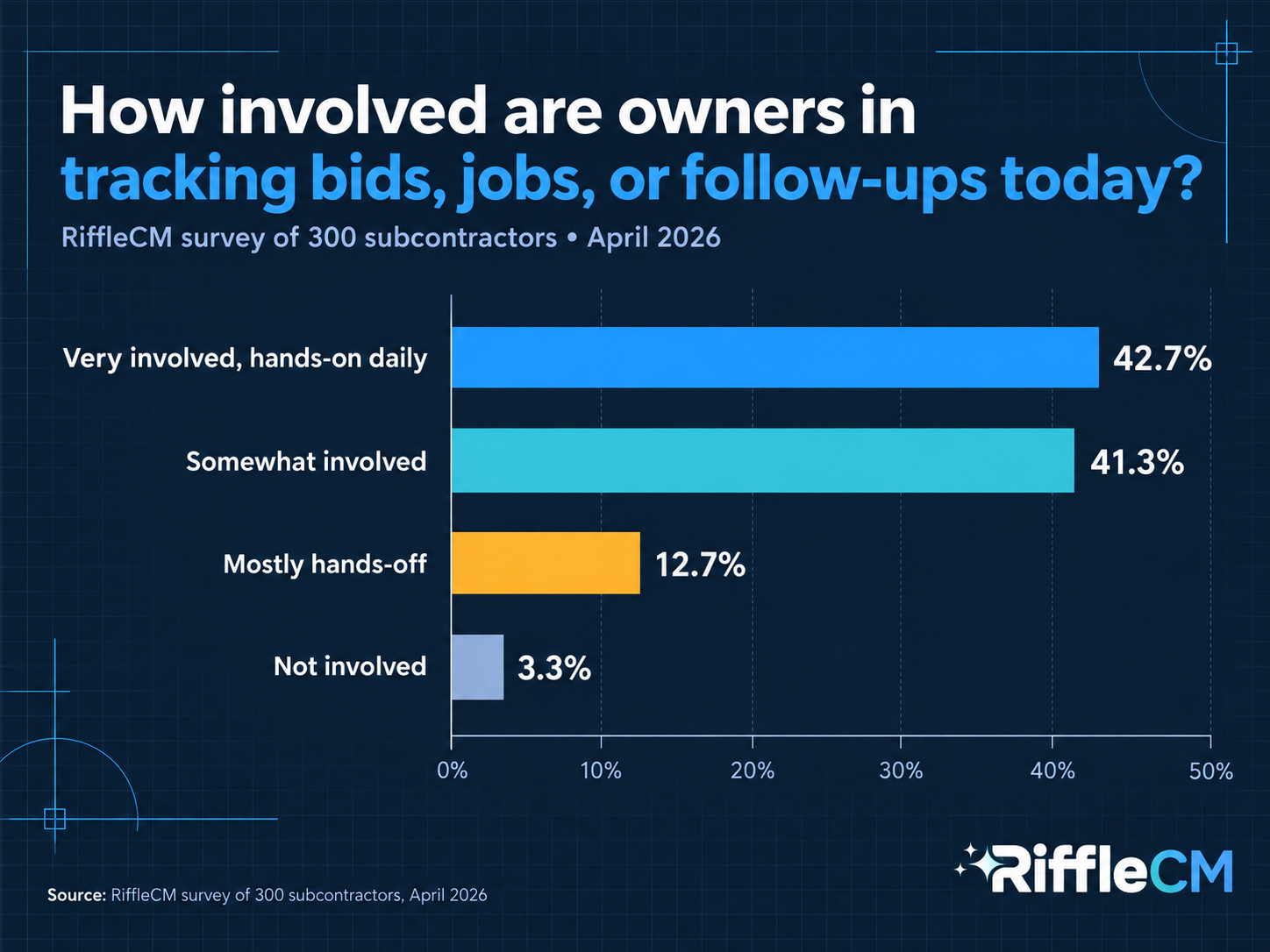
Direct involvement is not automatically a problem. In a smaller shop, it may be the most practical way to run the business. In a growing one, the owner may still have the deepest customer history, technical judgment, estimating context, and sense of risk.
The strain begins when routine operating information depends on that same person.
If a PM cannot tell what was carried in the estimate without calling you, if an estimator cannot see the history behind a GC relationship without asking you, or if accounting needs your memory to reconcile what happened on a job, your involvement is filling gaps in the way information moves through the company.
That is a rational response to the operating structure you inherited and built over time. The cost shows up when the business cannot function the same way without that response.
Why every question comes to you
Owner dependence usually begins with tools and habits that each work well enough on their own.
An ITB lands in email. Someone adds the due date to a spreadsheet. Drawings go into a shared folder. An estimator builds the number in another file. A GC clarification remains in an email thread. Once the job is awarded, the PM creates a project folder, accounting opens the job, and field information starts coming in through calls, texts, photos, RFIs, time entries, and conversations.
Each piece may be tracked. The problem is that no single place necessarily carries the whole story.
In a RiffleCM survey of 300 subcontractors, April 2026, 50% of respondents said ITBs and bid-related information are stored in email inboxes, 47% said spreadsheets, and 36% said shared folders. Q8 allowed multiple selections, so those percentages overlap. That overlap is part of the finding.
The same subcontractor can have one piece of a bid in an inbox, another in a spreadsheet, and the supporting files somewhere else. The system works as long as somebody knows how all those pieces connect.
The setup becomes harder when information has to move between estimators, PMs, foremen, accounting, and leadership.
In a RiffleCM survey of 300 subcontractors, April 2026, 46% of respondents said confusion happens occasionally once bids or jobs are in motion, while another 6% said it happens frequently. Combined, 52% reported confusion at one of those two levels.
Asked what usually causes that confusion, respondents pointed to the operating structure around the work. In a RiffleCM survey of 300 subcontractors, April 2026, 27% selected manual tracking, 25% selected information spread across too many tools, and 25% selected no standardized process.
Those answers matter because they point away from personality conflicts and toward how the business is organized.
Consider a bid-to-job handoff. The estimator knows why a labor assumption was aggressive. The proposal contains an exclusion. The owner remembers what the GC said during a call. The PM sees the awarded number. Later, the foreman finds a condition in the field that changes the work.
If those facts live in different places, the company has to reconstruct the context every time somebody needs to make a decision. That reconstruction often runs through you. The same issue appears when you try to answer the money question.
In a RiffleCM survey of 300 subcontractors, April 2026, 48% of respondents selected delayed or incomplete data, the most common response, as a barrier to understanding job profitability.
The company may have all the underlying information somewhere. Labor is in payroll. Purchase commitments are in another system or file. Change work may still be sitting in email. The original estimate lives with preconstruction. Actual costs arrive according to the accounting cycle. The answer only becomes useful after someone connects those pieces.
For many owner-led subcontractors, the owner has seen more of the story than anyone else. Your inbox, memory, and judgment become the integration layer between records that do not fully connect. At that point, the owner is the system.
Every “just ask the owner” may solve the immediate problem. Repeated across dozens of bids, jobs, crews, and customers, it creates a business whose information flow depends on one person.
For the broader multi-job operating problem, see What Project Management Actually Means for a pecialty Subcontractor.
For the profitability mechanics behind the same problem, see Job Costing for Subcontractors: A Practical Guide.
What it costs you now
The first cost is capacity.
A business that routes operating questions through one person can absorb only as much complexity as that person can keep straight. More bids create more pursue-or-pass decisions, deadlines, clarifications, and follow-ups. More active jobs create more handoffs, changes, schedule issues, commitments, and customer conversations. More crews create more field information that has to reach the office in a form someone can use.
The company can grow while the operating model stays owner-dependent. That is why the ceiling is easy to miss. You hire another estimator, PM, foreman, or office person. There are more capable people in the business, but they still need your context to finish parts of their work. Headcount rises without removing the central dependency. Eventually, your attention becomes the constraint.
Bid capacity can depend on how many opportunities you can personally review. Job capacity can depend on how many exceptions you can personally resolve. Crew count can depend on how many field issues can pass through you before something is delayed, misunderstood, or forgotten. This is where construction business owner burnout can show up as an operating symptom.
The useful question is not only why you cannot step away. Look at what keeps pulling you back in. How many ordinary questions still require information that only you can connect?
There is another cost: fragility.
Picture a composite situation familiar to many veteran owners. You take a real week away after years of checking your phone through every vacation. On Monday, a GC sends revised scope on a project due Wednesday. The estimator has the latest drawings but not the full relationship history. On Tuesday, a foreman reports added work on an active job. The PM knows something changed but cannot find where the GC acknowledged it. On Wednesday, accounting asks whether a material commitment belongs against base scope or a pending change.
None of those problems has to stop the company. They simply become slower and harder because the person who normally supplies the missing context is unavailable. A vacation can expose it. So can illness, a family event, a day spent entirely in the field, or one difficult project consuming most of your attention.
When too many operating answers depend on one person, the business has a single point of failure. Subcontractors themselves are already naming the areas that would relieve some of that pressure.
In a RiffleCM survey of 300 subcontractors, April 2026, 44% put better team coordination among their top three priorities for 2026, while 42% put clearer profitability in their top three. Those priorities belong together.
Better team coordination requires people to work from the same current information. Clearer profitability requires the estimate, labor, commitments, changes, and actual costs to come together while there is still time to act.
Both reduce the number of questions that have to find their way back to you.
What it costs you later
The same owner dependence that limits capacity today can follow the business into succession. A RiffleCM survey of 200 trade business owners, 2026, found that 87% had at least thought about succession, but only 57% had a clear plan.
That gap matters because a sale, family transition, or management buyout eventually forces a question daily operations can postpone: What continues when the owner is no longer the person connecting everything? What Trade Business Owners Told Us About Succession Planning covers that broader planning problem.
A buyer is looking at more than what the business earned while you were there. The buyer also has to judge whether the company can keep producing after you leave. That is where owner dependence becomes a valuation issue.
In the same RiffleCM survey of 200 trade business owners, 2026, 53% said consistent revenue growth and profitability are what make a trade business most valuable to a buyer, 31% named a strong management team that can operate without the owner, and 12% named well-documented processes.
Revenue and profitability obviously matter. The next question is how transferable the machinery behind those results really is. If customer history, pricing knowledge, job decisions, and operating context live mainly with the owner, a buyer has to take on the risk and work of rebuilding that continuity. That can affect what the business is worth to someone else.
A simple test makes the issue concrete. If you stopped answering routine questions for 30 days, would the team still know what is being bid, what was promised, what changed, what is at risk, and which jobs are making money?
The more of those answers disappear with you, the more continuity a new owner has to recreate. What Is Your Trade Business Actually Worth to a Buyer? goes deeper on how owner dependence affects transferability and business value.
There is also an opposite arrow worth seeing clearly. The Financial Dependence Trap: Why Trade Business Owners Can’t Afford to Stop Working looks at the owner depending financially on the business. The Financial Dependence Trap article looks at the business depending operationally on the owner.
Put the two directions together and the trap becomes easier to see. You need the company to keep producing income and value, while the company still needs you to keep ordinary work connected.
That is why owner dependence becomes an exit issue long before an exit is scheduled.
It was never a delegation problem
Delegation in construction is often framed around trust.
Give the PM more authority. Let the estimator own the bid. Stop checking everything. Get out of the weeds. That advice can help when the people receiving the responsibility already have the information they need.
It is much less useful when the information itself is fragmented. You cannot cleanly hand off responsibility when the context required to perform it lives mainly in your inbox, your memory, or your personal understanding of how several disconnected records fit together.
A PM can own a job, but that ownership has limits if the PM cannot see estimate assumptions, approved changes, commitments, field status, and current profitability.
An estimator can own a bid, but the handoff remains fragile if prior GC conversations and outcomes live somewhere else.
A foreman can report a field issue, but that information loses value if there is no standard path for it to reach the people managing scope, cost, and billing.
The way out is architectural. Bids, jobs, changes, and outcomes need a reliable place to live. The team needs a standard process it can follow without rebuilding the logic from memory.
Profitability information needs to arrive while there is still enough job left to change the result. Project and customer history need to remain useful when somebody takes a vacation, changes roles, leaves the company, or eventually sells the business.
That does not require a company-wide transformation on day one. Start with the question your team asks you most.
Maybe it is:
“Are we bidding this?”
“What did we carry?”
“Did the GC approve that?”
“Where are we on this job?”
“Did we make money?”
Pick one recurring question and trace why its answer still has to come from you. Then change the workflow so that answer exists somewhere the responsible person can find, update, and trust without calling you.
Once that question stops routing through you, take the next one. Owner dependence usually accumulates quietly, one routed question at a time. It can unwind the same way.
The companion resource, Why Can’t My Team Run Jobs Without Me?, will take the personal version of this question further when published. The companion, Owner Dependence in a Trade Business: What It Costs and How to Reduce It, will cover the broader costs-and-reduction program.
Frequently Asked Questions
Why do subcontractor owners stay so involved in daily operations?
RiffleCM’s survey data suggests much of that involvement is structural. Bid information is often split across inboxes, spreadsheets, and folders, while confusion appears once work is moving. When no shared operating record connects those pieces, the owner often becomes the person who holds enough context to answer routine questions.
Is owner involvement bad for a contracting business?
Owner judgment can be a major advantage, especially on pricing, relationships, risk, and difficult project decisions. The liability appears when routine information also depends on the owner. That limits team capacity, creates a single point of failure, and makes the company harder to operate or transfer without that person.
How does owner dependence affect what a business is worth?
Buyers care about what continues after closing. If customer history, pricing knowledge, job context, and everyday operating decisions are difficult to separate from the owner, the buyer takes on more transition risk. Reducing that dependence makes the company’s earnings, processes, and relationships easier to carry forward after a sale.
How do you make a sub business less dependent on the owner?
Change where information lives and how it moves. Keep bids, jobs, changes, and outcomes in a reliable shared record, use a standard process the team can follow, and make profitability information available while it is actionable. Start with the question your team asks you most and make its answer exist somewhere besides you.
The owner’s daily involvement can keep a fragmented business moving for years. The danger comes when the workaround quietly becomes the operating plan.
Make the information survive your absence, and the business has more room to grow, run, and eventually transfer without losing the judgment that helped build it.
Last updated: September 2026
Eliminating Manual Errors in Construction Bids
Common questions about reducing errors and improving accuracy
What causes most manual errors in subcontractor bids?
Manual errors usually come from disconnected workflows — things like outdated spreadsheets, inconsistent templates, or rekeying the same data multiple times. When project info lives across emails, texts, and PDFs, small mistakes add up fast.
How can software help reduce bidding mistakes?
Purpose-built estimating software automates repetitive tasks like data entry, quantity takeoffs, and revision tracking. Instead of chasing down the latest drawings or retyping costs, your team works from one centralized, accurate system — cutting errors before they happen.
Is automation complicated to set up for small subcontractors?
Not with modern tools like Riffle. You can connect your email or ITB inbox in minutes, and automation starts working behind the scenes — identifying bid invites, tracking updates, and helping you prioritize the right opportunities. No IT department required.
How much time can automation actually save?
Most subcontractors save 6–10 hours per week just by eliminating manual re-entry and version confusion. That’s more time for estimating the next job, reviewing margins, or simply getting home on time.
Does automating bids mean losing control over pricing?
Not at all. Automation handles the busywork — you keep full control over pricing, scope, and judgment calls. Think of it as an assistant that gets the numbers right so you can focus on strategy.
How do I know if my team is underspending or overspending on software?
A good rule of thumb: most subcontractors invest 1–3% of annual revenue in digital tools. If you’re still running bids manually or using outdated systems, the real cost might be hidden in lost time and missed opportunities.
Why does accuracy matter so much in bidding?
Every error compounds — one missed line item or miscalculated rate can erase your entire profit margin. Accuracy doesn’t just win jobs; it protects your business from losses you don’t see coming.
How does Riffle help subcontractors eliminate manual work?
Riffle automates your bidding and project workflows from start to finish. It finds ITBs in your inbox, organizes bid invites, fills in estimating data, and tracks updates — helping subcontractors bid smarter, reduce errors, and grow revenue.
We Understand the Bottlenecks for Subs

My biggest weakness has always been follow-ups—I’m just not great at it. If I had a built-in reminder feature to follow up on projects automatically, that would be a game-changer. I’ve gotten better, but I could still use that extra nudge.
Quoting can be chaotic. You have five different contractors sending out the same bid invite, each named differently. We end up with duplicate bids on the board or miss one entirely because it was labeled another way. There is no clear procedure when invites come in from multiple people.
Stay Informed
Get the latest on subcontractor business trends, research, and tools to help you grow profitably. Delivered monthly.