

The Profitability Blind Spot: What 200 Subcontractors Told Us About Knowing Their Numbers
A survey of 200 U.S. subcontractors reveals a gap between confidence and timely profit visibility, and why the numbers often arrive too late to act.

.png)
Table Of Contents
Last updated: September 2026
Subcontractor profitability looks well understood until recent job results enter the picture. In our August 2026 survey of 200 U.S. subcontractors, 92% said they track job profitability very or somewhat well. Yet 48.5% had missed their bid margin on at least four of their last ten jobs, and only 41% could identify their most profitable GC relationship with data behind the answer.
That gap is the profitability blind spot: the distance between how well subs think they see their numbers and when those numbers actually arrive.
About the data: In August 2026, RiffleCM surveyed 200 U.S. subcontractors through Pollfish, an independent survey panel. General contractors were screened out, and every respondent reviews job costs, margins, or financial performance as part of their work; 58% review them regularly and make decisions based on them. Respondents span electrical, mechanical, plumbing, concrete, drywall, painting, roofing, landscaping, and multi-trade shops. RiffleCM builds software for subcontractors, including profitability tracking, so read our interest in the topic accordingly. We report the numbers as they came back, including the ones that surprised us.
1. The confidence is real. The visibility isn't.
Start with the number that frames the rest of the survey: 92% of subcontractors say they track job profitability very or somewhat well. The split is nearly even, with 45.5% saying “very well” and 46.5% saying “somewhat well.”
That confidence showed up in a separate 2026 tools survey too. In that sample of 300 subcontractors, 90% said they track profitability.
The recent-job results are less comfortable. Only 24.5% said they hit their bid margin on nine or ten of their last ten jobs. Another 48.5% said they missed margin on at least four of those ten.
Even strong self-reported tracking did not reliably line up with stronger outcomes. Among respondents who said they track profitability well, 47% still missed their bid margin on half or more of their recent jobs.
The GC view adds a counterweight. In a separate survey of 300 general contractors, 81% said subcontractors miss their original estimate or bid amount on at least one job in ten, and 30% said it happens on a quarter of jobs or more.
The point is not that subcontractors fail to track. The survey suggests that tracking can still produce an answer too late to help the active job. A clean final report and timely operating visibility are different things.
For the full citable benchmark set, see Subcontractor Profitability Statistics 2026. For the software-evaluation side of the problem, see 7 Margin Tracking Lessons in Subcontractor Software.
.png)
2. Most subs find out when it's too late
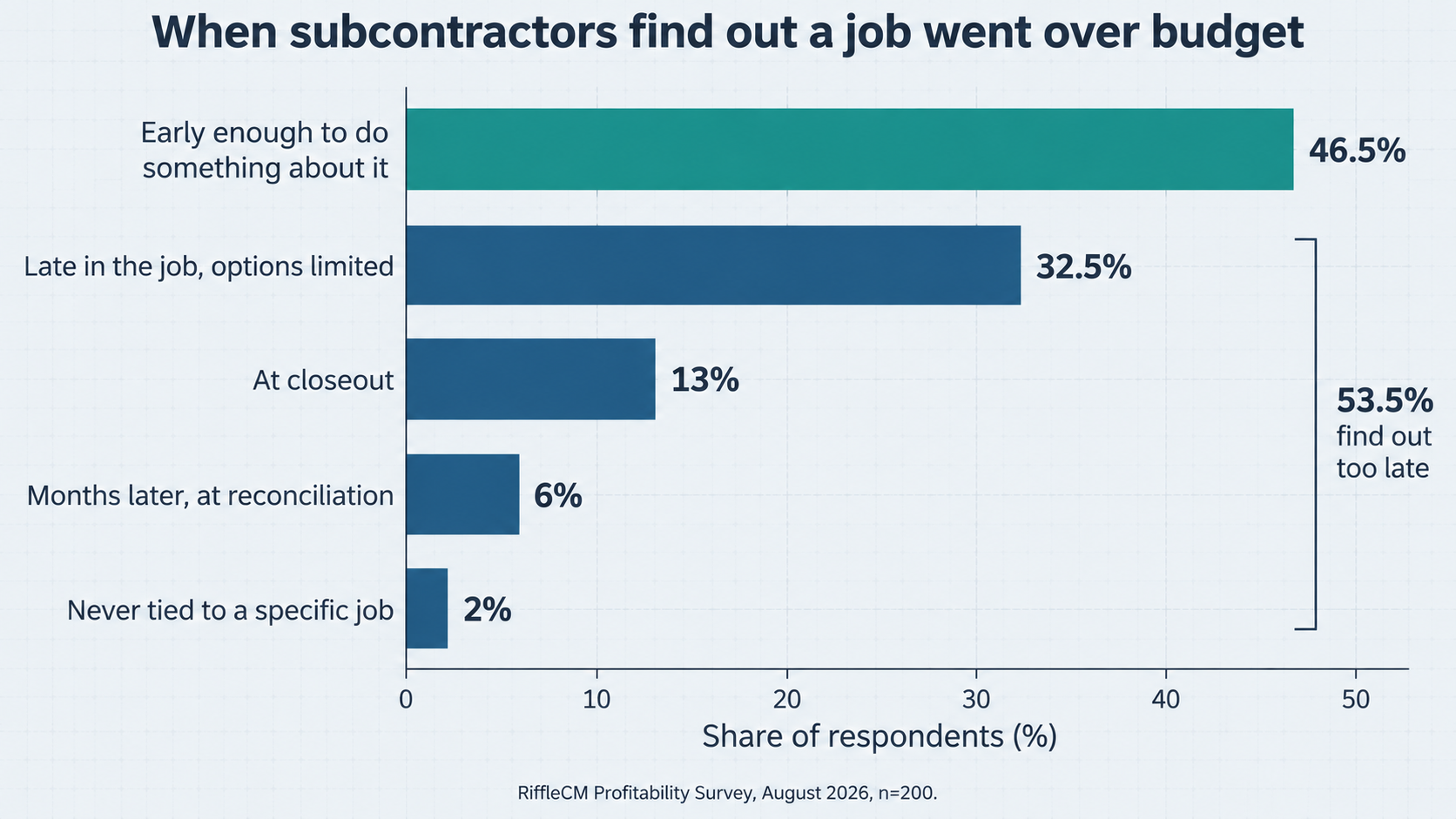
We asked when subcontractors typically find out a job has gone over budget.
Only 46.5% said they find out early enough to do something about it. The remaining 53.5% land later: 32.5% find out late in the job when options are limited, 13% at closeout, 6% months later during reconciliation, and 2% never connect the loss to a specific job.
Confidence does not solve the timing problem by itself. Among respondents who said they track profitability “very well,” 41% still reported finding out too late to act.
This is where job profitability tracking can look stronger on paper than it feels in the field. Labor hours may be in payroll. Material invoices may be in accounting. Open commitments may live somewhere else. The estimate that set the expected margin may still be with preconstruction.
Each number can be accurate on its own while the current construction profit margin remains unresolved. By the time closeout settles the answer, the operating choices attached to that answer may already be gone.
3. The gut-feel economy
Fifty-one percent of respondents said they track profitability by GC or customer with real numbers.
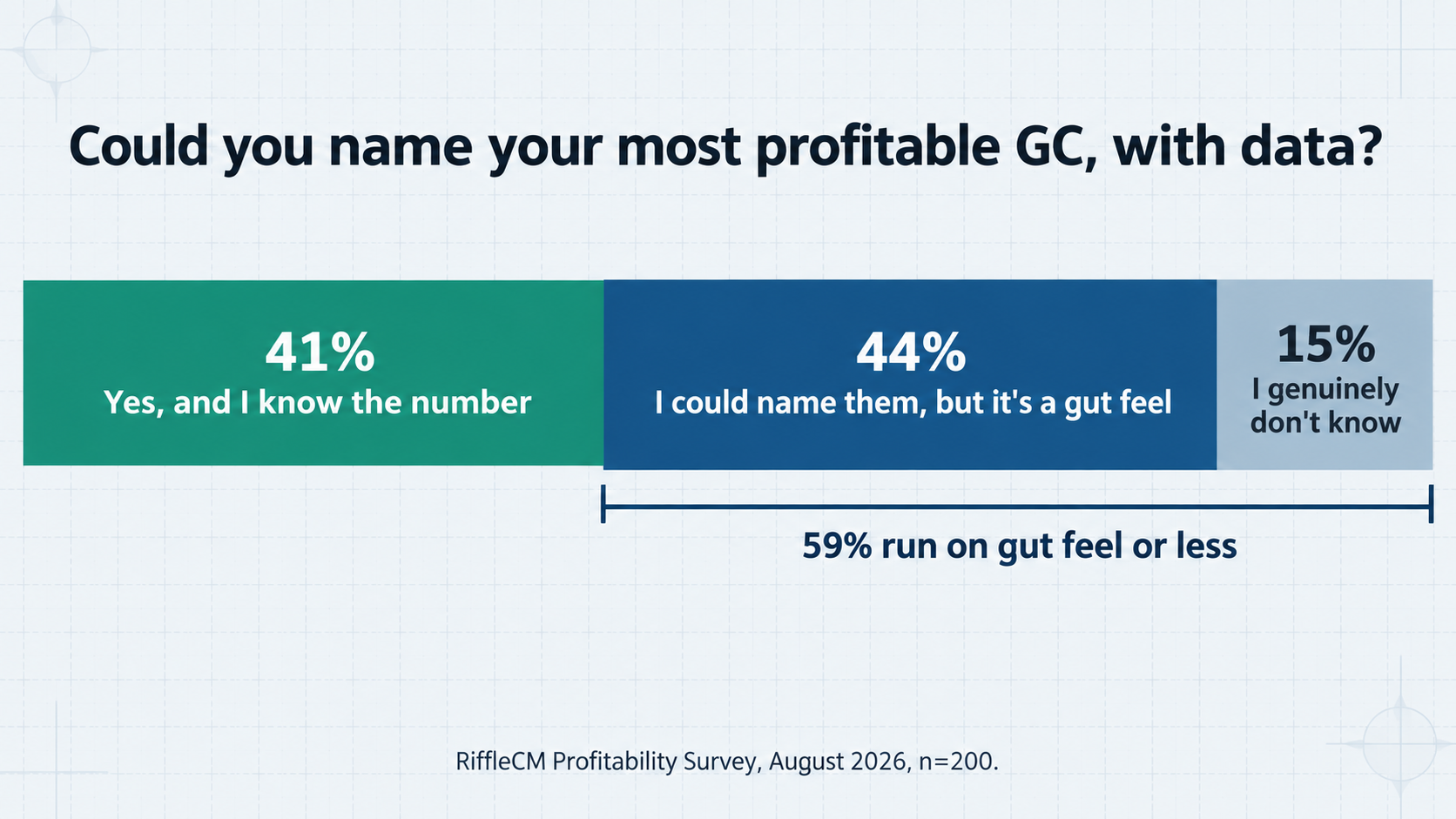
So we asked a simpler test question: could they name their most profitable GC relationship right now and support the answer with data?
Forty-one percent said yes. Another 44% said they could name the GC, but the answer would be based on gut feel. Fifteen percent genuinely did not know.
There is another gap inside the 51% who said the data exists. Among those respondents, 43% could not produce the number when asked directly.
Instinct deserves respect here. Subcontracting is a relationship business, and years of working with the same customers teach an owner how PMs communicate, where schedules tend to break down, and which relationships feel worth chasing. That judgment built plenty of good subcontracting businesses.
Its weakness shows up when memory has to carry the economics of the whole relationship. Customer profitability accumulates across multiple jobs, different project teams, payment patterns, change-order friction, and years. A GC can feel like a strong account because the work is steady while the financial rollup points somewhere else.
4. 61% have been burned
The downside of that visibility gap is already familiar to many respondents.
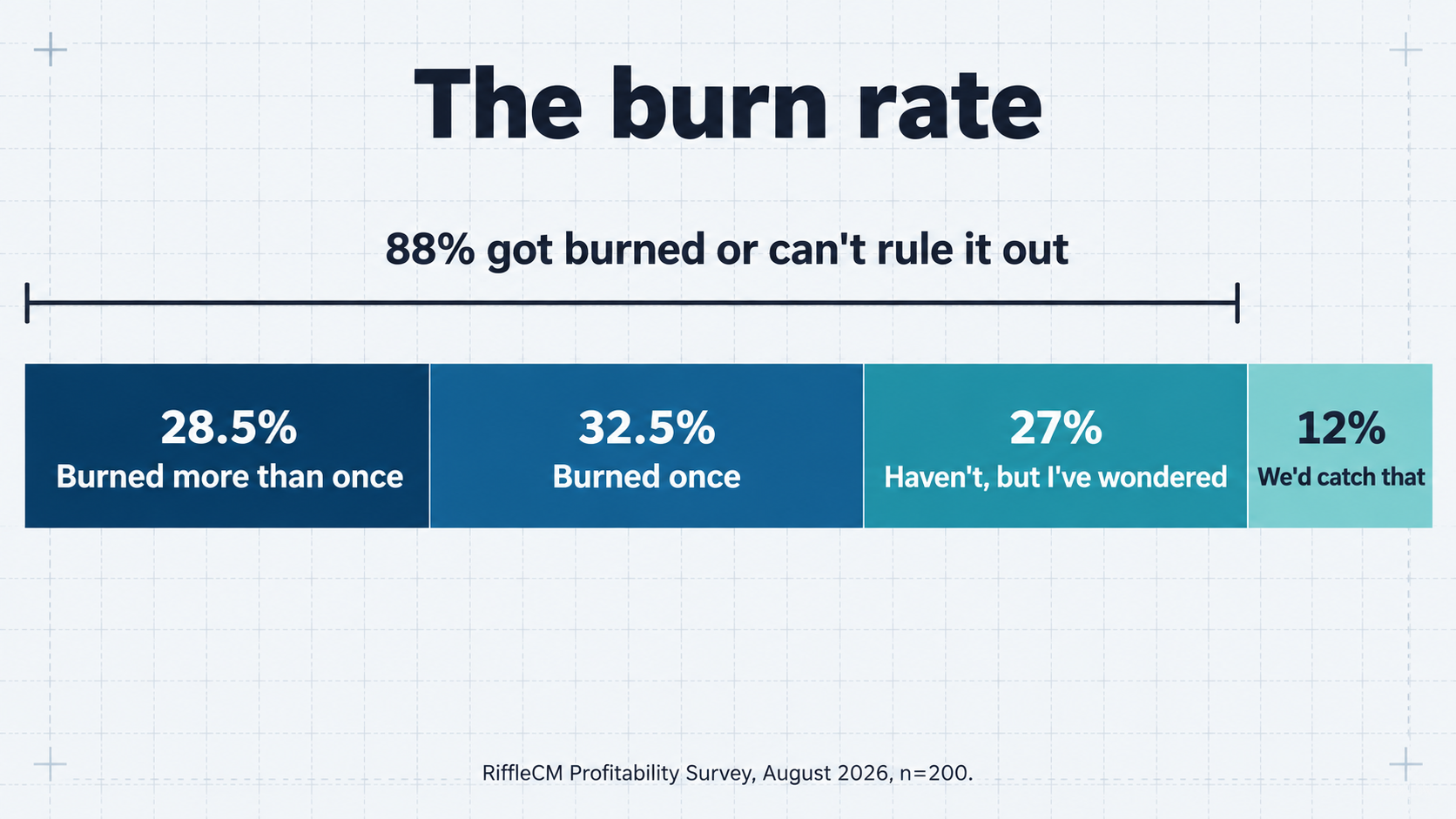
Sixty-one percent said they had discovered that a GC relationship they thought was good was actually losing them money. For 28.5% of the full sample, that had happened more than once.
Another 27% said they had wondered whether a supposedly profitable relationship was losing money. Only 12% said they were confident their systems would catch it.
Together, 88% had either discovered a losing relationship or could not confidently rule one out.
Owners did not escape the pattern. Among owners and presidents in the sample, 72% said they had been burned. That subgroup contained 29 respondents, so it is supporting evidence rather than the headline.
The structural issue is straightforward. A project report answers what happened on one job. Profitability by customer requires every job for that GC to be rolled together and compared over time.
That view has to span good jobs, bad jobs, different PMs, project sizes, payment patterns, and years. Many firms do not have that cross-job rollup readily available, which leaves the customer-level answer dependent on manual assembly or memory.
For the full customer-profitability distribution, see Subcontractor Profitability Statistics 2026.
5. Change orders, both directions
Change orders produced some of the survey’s clearest self-critique.
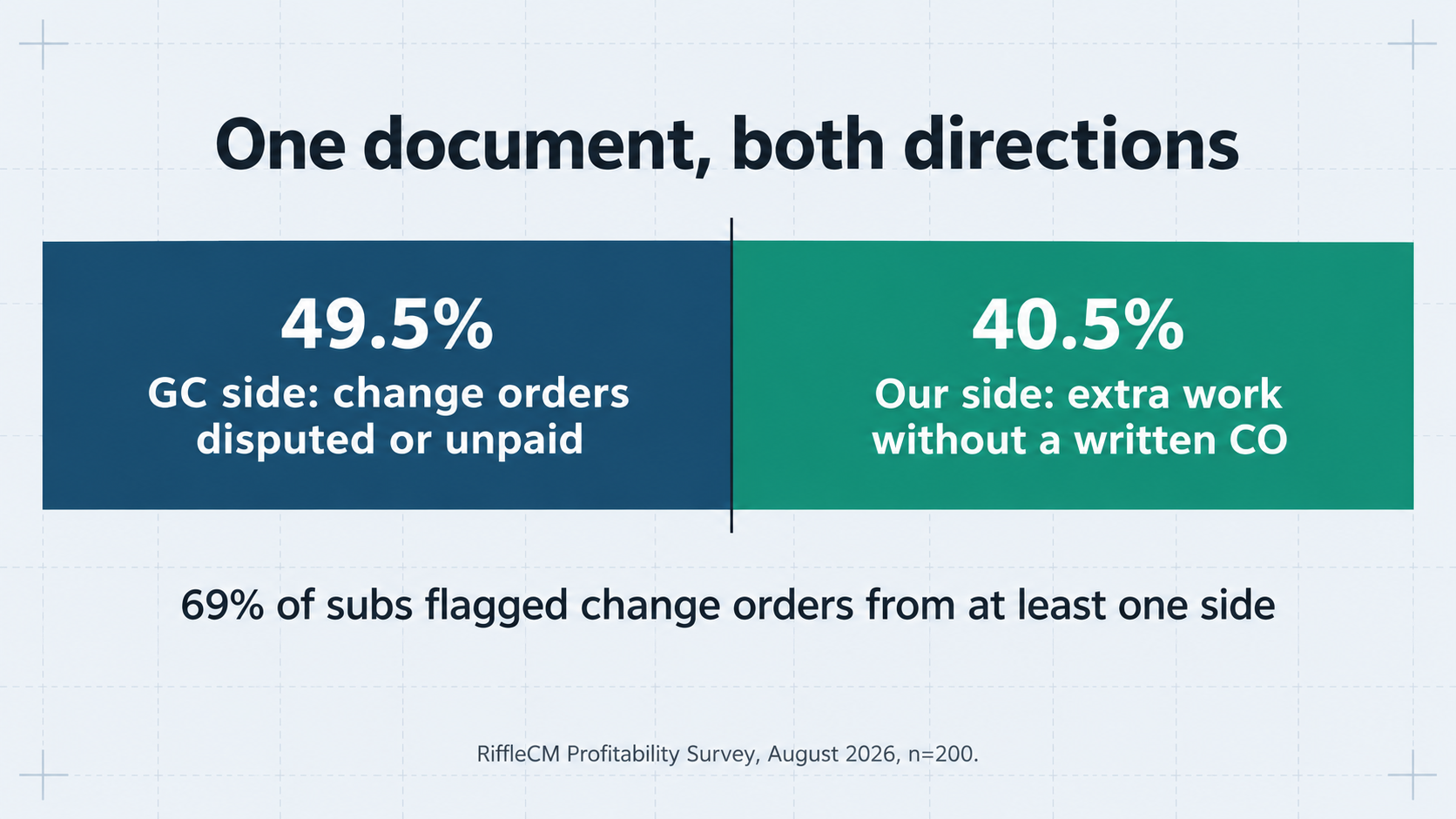
When respondents were asked which GC behaviors cost them the most margin, disputed or unpaid change orders ranked first at 49.5%. Slow pay followed at 32.5%, with retainage held too long at 28%.
Then the question turned around. Asked which of their own habits cost margin, 40.5% chose doing extra work without getting the change order in writing.
Across both sides of the relationship, 69% of respondents flagged change orders from at least one direction.
Only 3% said nothing came to mind when asked which of their own habits hurt profitability.
That 3% matters because the responses were not simply complaints about customers. Subcontractors were willing to point back at their own side of the work.
The findings also show why active-job profit can be difficult to read. Cost and revenue do not necessarily become visible at the same point in a project. The survey captures that tension without assuming every contract, customer, or change follows the same pattern.
6. What the early-catchers have in common
Committed-cost visibility is one place where the timing gap becomes measurable.
Forty-five and a half percent of respondents said they can see committed costs against the estimate on demand. Another 32% said they can get the number, but someone has to pull it together.
We compared that answer with when respondents said they discover a job is going over budget.
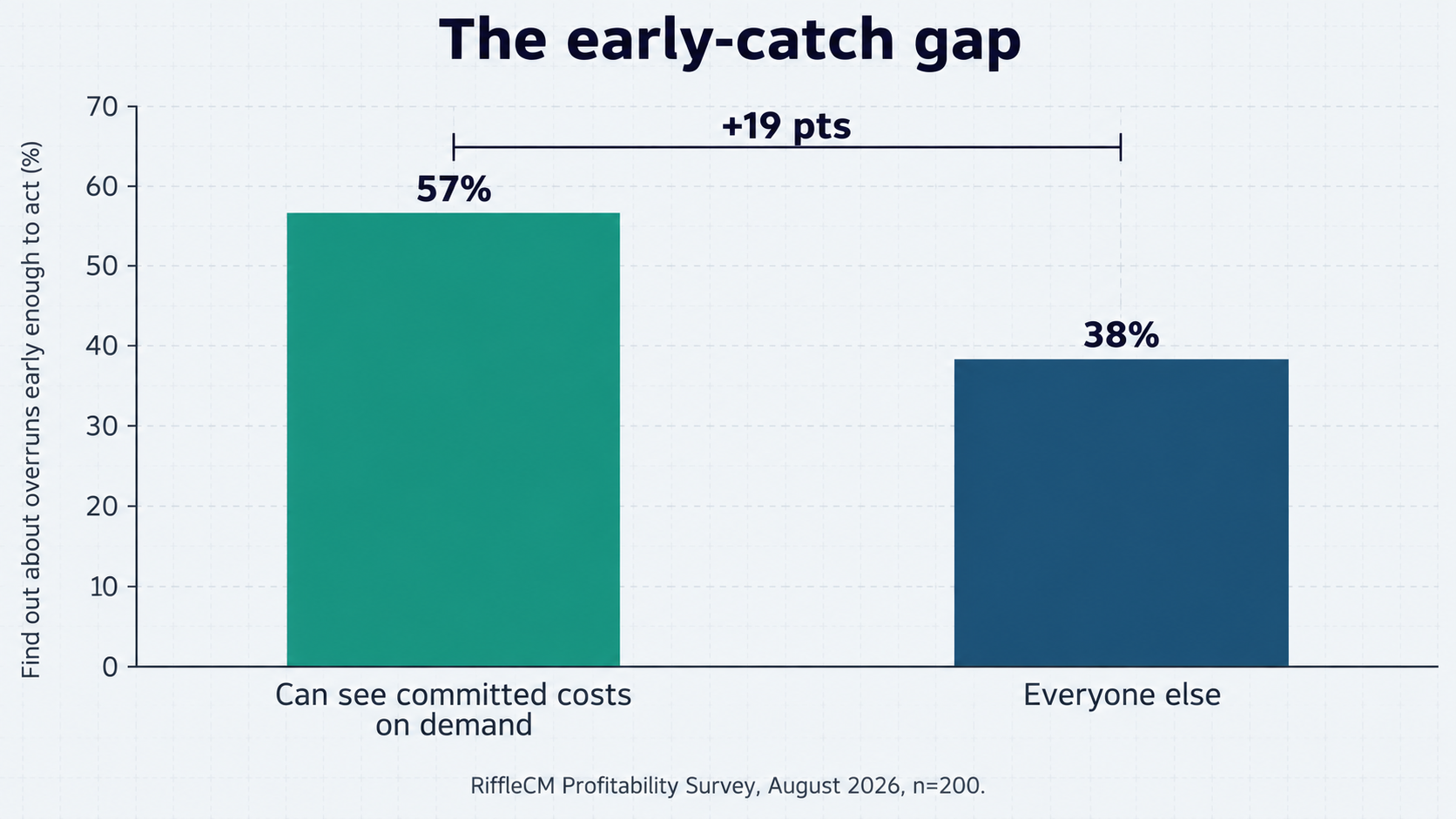
Among subcontractors with on-demand committed-cost visibility, 57% said they find out early enough to act. Among everyone else, 38% said the same.
That is a 19-point gap.
This is correlation in survey data, and the result should be read that way. It does not establish that committed-cost visibility caused earlier discovery.
The operating mechanism is still ordinary. A purchase order, sub-tier commitment, committed labor, rental, or other obligation can affect where a job is heading before the final invoice reaches the ledger. Nobody can react to a number that has not reached the operating view.
Subs who can see committed costs on demand are far more likely to find out early in this survey.
For the mechanics behind that view, see Job Costing for Subcontractors: A Practical Guide. For the accounting-versus-operations gap, see Why Can’t QuickBooks Tell Me If a Job Made Money?.
7. The number they want is labor
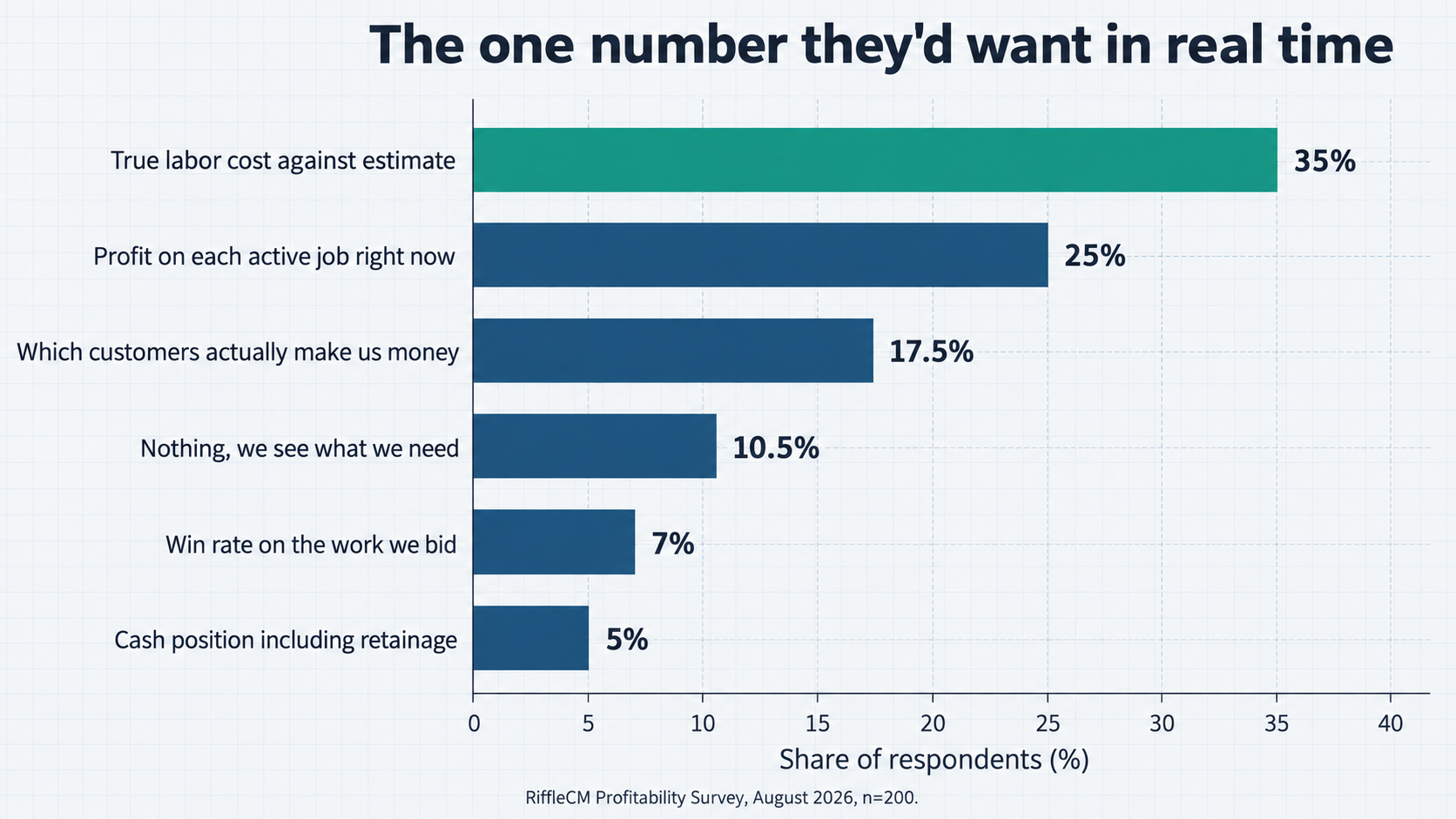
We closed by asking which single number respondents would want in real time that they cannot see today.
True labor cost against estimate ranked first at 35%. Profit on each active job came next at 25%, followed by which customers actually make money at 17.5%. Another 10.5% said they already see what they need. Win rate accounted for 7%, and cash position including retainage accounted for 5%.
Labor leading the list fits the rest of the survey. Labor overruns were the second-most-common reason respondents gave for jobs losing money, at 20%. Labor-related misses also appeared among the habits respondents acknowledged can hurt profitability.
Labor moves every day. Hours keep accumulating while productivity shifts with crew mix, access, sequencing, supervision, and field conditions. The field can recognize that a phase is burning too many hours before the final financial answer catches up.
The 7% who chose win rate are asking an upstream version of the same visibility question: which estimating effort actually converts into work? Most Subs Don’t Know Their Win Rate. It’s the Most Expensive Number They’re Not Tracking goes deeper on that preconstruction question.
The blind spot, named
Put the findings together and the recurring issue is timing.
Subcontractors are broadly confident in their profitability tracking, yet margin misses are common in the recent jobs they described. More than half find out about overruns after the best decision window has passed. Customer profitability often sits across jobs rather than in one usable view. Labor can move before the report does.
By closeout, the answer is clearer. Much of its operating value has already expired.
The survey supports a correlational conclusion: respondents with on-demand committed-cost visibility were more likely to report catching overruns early.
That fits the rest of the findings. Costs can reconcile after the work has moved. Relationship profitability can remain scattered across individual projects. Field conditions can change faster than the financial picture catches up.
That is the profitability blind spot. The information may already exist somewhere in the business. The useful version arrives while the job can still change.
See the numbers while the job is still moving
If committed-cost visibility is part of the gap you are trying to close, see how RiffleCM approaches the subcontractor workflow.
FAQ
How many subcontractors can back their best GC relationship with data?
In the August 2026 survey of 200 U.S. subcontractors, 41% could identify their most profitable GC relationship and support the answer with data. Another 44% said the answer would be based on gut feel, while 15% said they did not know.
What do recent jobs reveal about bid-margin performance?
Among the subcontractors surveyed in August 2026, 48.5% said they missed bid margin on at least four of their last ten jobs. At the other end, 24.5% said they hit bid margin on nine or ten of their last ten jobs.
When does profitability information arrive too late to change the job?
In the August 2026 survey, 53.5% reported learning about the overrun after the early-action window, including late in the job, at closeout, during later accounting reconciliation, or never tying the loss to a specific job. Another 46.5% said they find out early enough to act.
Which GC-side issues show up most often in margin loss?
In the August 2026 survey, disputed or unpaid change orders ranked first among GC behaviors at 49.5%, followed by slow payment at 32.5% and retainage held too long at 28%. These percentages report what respondents selected as having the greatest effect on margin.
Eliminating Manual Errors in Construction Bids
Common questions about reducing errors and improving accuracy
What causes most manual errors in subcontractor bids?
Manual errors usually come from disconnected workflows — things like outdated spreadsheets, inconsistent templates, or rekeying the same data multiple times. When project info lives across emails, texts, and PDFs, small mistakes add up fast.
How can software help reduce bidding mistakes?
Purpose-built estimating software automates repetitive tasks like data entry, quantity takeoffs, and revision tracking. Instead of chasing down the latest drawings or retyping costs, your team works from one centralized, accurate system — cutting errors before they happen.
Is automation complicated to set up for small subcontractors?
Not with modern tools like Riffle. You can connect your email or ITB inbox in minutes, and automation starts working behind the scenes — identifying bid invites, tracking updates, and helping you prioritize the right opportunities. No IT department required.
How much time can automation actually save?
Most subcontractors save 6–10 hours per week just by eliminating manual re-entry and version confusion. That’s more time for estimating the next job, reviewing margins, or simply getting home on time.
Does automating bids mean losing control over pricing?
Not at all. Automation handles the busywork — you keep full control over pricing, scope, and judgment calls. Think of it as an assistant that gets the numbers right so you can focus on strategy.
How do I know if my team is underspending or overspending on software?
A good rule of thumb: most subcontractors invest 1–3% of annual revenue in digital tools. If you’re still running bids manually or using outdated systems, the real cost might be hidden in lost time and missed opportunities.
Why does accuracy matter so much in bidding?
Every error compounds — one missed line item or miscalculated rate can erase your entire profit margin. Accuracy doesn’t just win jobs; it protects your business from losses you don’t see coming.
How does Riffle help subcontractors eliminate manual work?
Riffle automates your bidding and project workflows from start to finish. It finds ITBs in your inbox, organizes bid invites, fills in estimating data, and tracks updates — helping subcontractors bid smarter, reduce errors, and grow revenue.
We Understand the Bottlenecks for Subs

My biggest weakness has always been follow-ups—I’m just not great at it. If I had a built-in reminder feature to follow up on projects automatically, that would be a game-changer. I’ve gotten better, but I could still use that extra nudge.
Quoting can be chaotic. You have five different contractors sending out the same bid invite, each named differently. We end up with duplicate bids on the board or miss one entirely because it was labeled another way. There is no clear procedure when invites come in from multiple people.
Stay Informed
Get the latest on subcontractor business trends, research, and tools to help you grow profitably. Delivered monthly.