

What General Contractors Really Think About Subs: New Data on Accuracy, Pricing, Tech, and Trust
We asked GCs across the U.S. what they really want from subcontractors — and what makes them hesitate. Their answers were blunt: reliability beats price, communication beats software, and predictable subs get hired again. This survey breaks down the data behind GC trust, the top decision drivers, the biggest pain points, and the simple behaviors that help subs win more work.
.jpg)

Table Of Contents
Executive Summary
General Contractors told us plainly what separates great subs from the ones they avoid: reliability, communication, quality of work, and trustworthiness.
We surveyed hundreds of GCs across the U.S. to understand:
- How accurate they believe subcontractor estimates are
- What drives their bid decisions
- Where subs create friction
- How subs can win more work
- And what truly makes a subcontractor stand out
The findings reveal a clear gap between what subs think matters and what GCs actually care about. It turns out price is not the biggest driver. Technology is not the differentiator.
This report breaks down how GCs evaluate subs, what they wish subs understood better, and the specific moves subs can make today to inspire trust, reduce friction, and win more work.
Introduction: If Subs Want to Win More Work, They Need to Hear This
When we asked GCs across the country what makes a subcontractor stand out, they didn’t talk about who was the cheapest.
They didn’t talk about software, marketing, logos, or fancy estimate packages.
They talked about:
- Showing up
- Doing what you say you’ll do
- Finishing on time
- Communicating clearly
- Delivering high-quality work
And they said it over and over again, in hundreds of different ways.
In the words of one respondent:
“If they show up on time and do what they say, they’re already ahead of most subs.”
Subs often assume GCs choose the lowest number.
GCs say the opposite: they choose the number they can trust.
This report shows exactly what GCs look for, where subs fall short, and what the top-performing subs do differently.
How Accurate GCs Think Subcontractor Estimates Really Are
GC confidence in sub estimates is mixed…and often lower than subs might expect.
Some trust subs, many trust them only “sometimes,” and a meaningful group sees chronic inaccuracies.
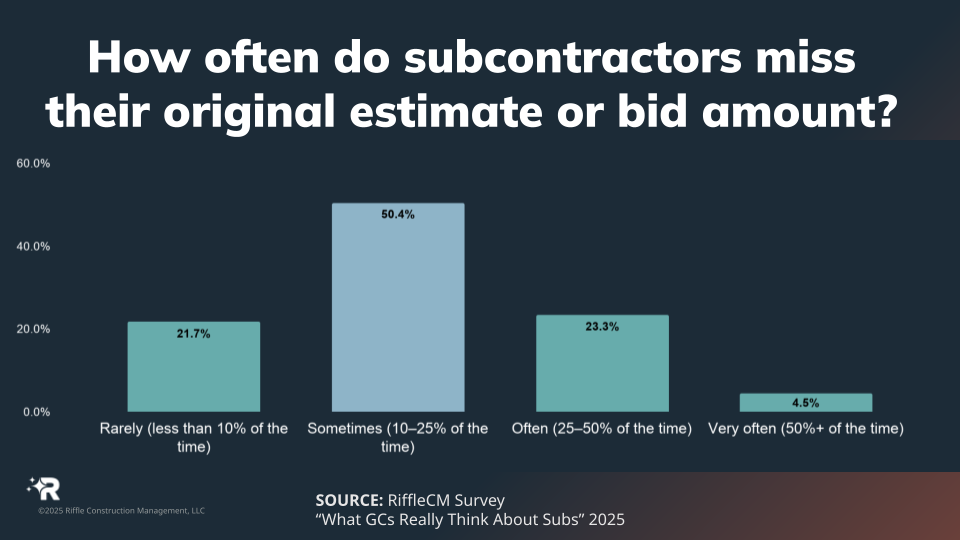
GC takeaway: They don’t need perfect estimates — they need transparent ones.
What Drives GC Bid Decisions
When we asked GCs which factors matter most when selecting subcontractors, the hierarchy was unmistakable and overwhelmingly consistent across roles, regions, and company sizes.
The top decision drivers were:
- Quality of work
- Price / competitiveness
- Ability to meet deadlines
- Experience with similar projects
- Prior relationship and trust
- Safety record
Notice what isn’t at the top of the list:
Communication and technology barely register unless subs are already reliable.
For GCs, the decision ultimately comes down to risk reduction — trusting that a sub will show up, perform well, finish on time, and make the GC look good in front of the owner.
As one respondent put it:
“You can tell within minutes if they’re going to be a good fit.”
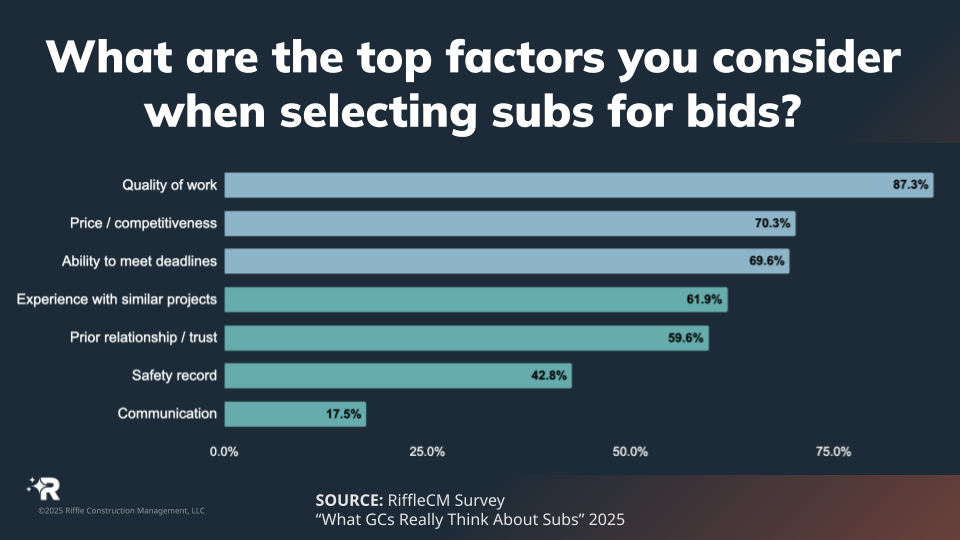
GCs make decisions based on risk reduction, not just price. Quality, schedule performance, and predictability dominate their selection criteria, while communication and even safety matter less than subs might expect. The takeaway is clear: subs win more work by proving they can deliver consistently—not by undercutting on price or overloading proposals with detail.
Where Subs Create Friction (According to GCs)
The survey shows several consistent pain points:
A) Scope clarity issues
GCs frequently said they need to “chase subs” for missing details.
B) Slow response times
This came up repeatedly in open text.
C) Inconsistent communication
Even one dropped thread destroys trust.
D) Missing alternates or VE options
GCs rarely get the options they need to protect budgets and schedules.
E) Poor follow-through
This includes disappearing between estimate and award.
GC real-talk:
“Great subs communicate. Bad ones disappear.”
“If I don’t have issues with them, I rehire them. Simple.”
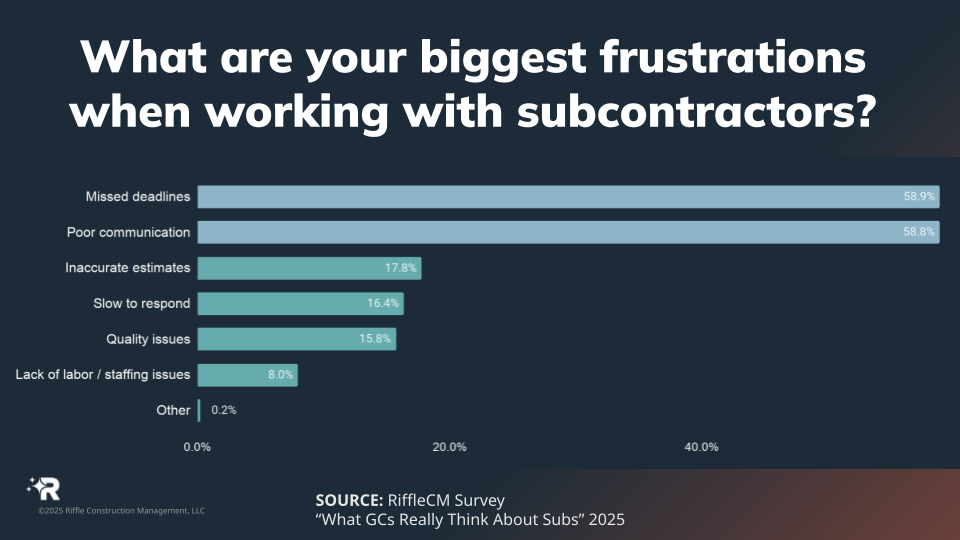
These frustrations paint a clear picture: GCs don’t struggle with complex project details as much as they struggle with basic reliability and communication gaps. Subs who respond quickly, deliver accurate information, and hit deadlines consistently remove the biggest sources of GC stress… and get hired again.
What Makes Subs Stand Out
We asked hundreds of GCs a simple open-ended question:
“What makes a subcontractor stand out (positively or negatively)?”
Across hundreds of open responses, six themes emerged… nearly identical regardless of region, role, or company size.
Theme 1: Reliability is the #1 differentiator
This is the single strongest theme in the entire dataset.
“Reliability makes the biggest difference.”
“If they hit deadlines every time, they’re unforgettable.”
“Being on time with everything puts them way ahead.”
Subs dramatically underestimate how much reliability influences GC trust.
Theme 2: Quality of Work = Reputation
Craftsmanship, attention to detail, and pride in work were mentioned constantly.
“Quality of work is everything.”
“You can see their pride in the work.”
GCs assume price will fluctuate — but quality cannot.
Theme 3: Communication (proactive, clear, responsive)
This is the second most emotional theme. GCs deeply resent subs who communicate reactively or inconsistently.
“Great communication is the difference between a good sub and a bad one.”
“Poor communication is the biggest red flag.”
“If they keep me updated and don’t make me chase them, they stand out.”
Theme 4: Professionalism & Work Ethic
Trust, honesty, preparedness, attitude — these are dealmakers.
“You can tell within minutes if they’re going to be a good fit.”
“If they’re honest and dependable, they stand out.”
Subs who are stable, professional, and consistent create confidence.
Theme 5: Experience & Reviews
Subs with a strong history and portfolio stand out immediately.
“Their track record speaks volumes.”
“Good reviews tell me everything I need to know.”
GCs use reputation as a proxy for risk.
Theme 6: Timeliness & Schedule Discipline
On time = trustworthy.
Late = risk.
“Always on time and under deadline.”
“Hitting deadlines, even if it means extra hours, stands out a lot.”
Tech Won’t Save a Bad Sub — But It Can Level Up a Good One
GCs are blunt about technology:
They don’t care what software a sub uses — they care whether that software makes the sub more reliable.
Our respondents put it plainly:
- They’re open, but skeptical of new tools.
- They trust subs more when tech leads to better communication, clearer bids, and fewer surprises.
- But if a sub asks them to log in somewhere, download something, or chase information? Confidence drops fast.
To GCs, technology is not the story.
Predictability is the story — tech is just a tool to get there.
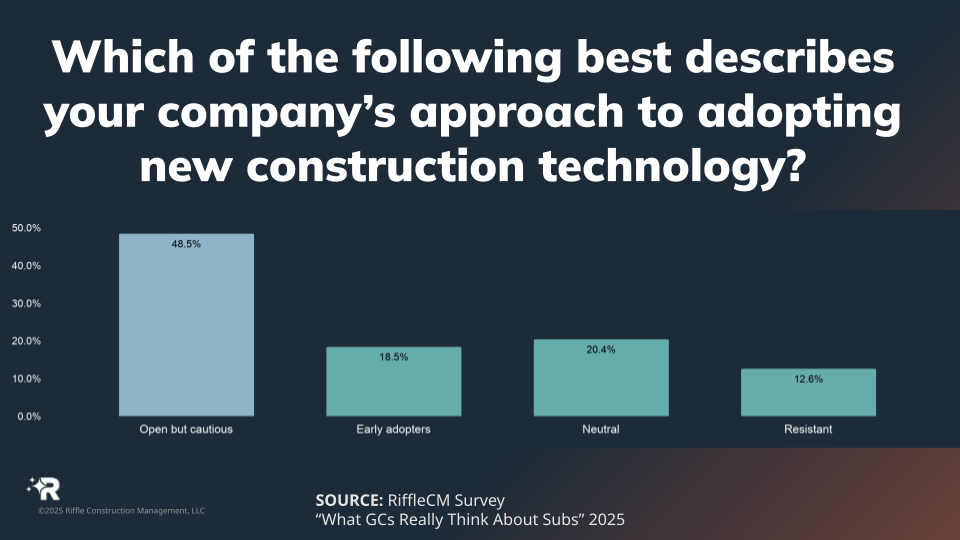
GCs don’t reject technology; they just don’t trust anything that makes their job harder. Tools that simplify communication, clarify scope, and keep timelines on track boost confidence. But anything that adds steps, logins, or friction backfires quickly. For GCs, technology is valuable only when it makes subcontractors more predictable.
Who We Heard From: GC Demographics
Our respondents represent a broad and highly practical cross-section of the general contracting community across the U.S. Their backgrounds and project environments help contextualize the results — and explain why reliability, communication, and accuracy ranked so high throughout the survey.
Role Level
GC decision-making authority was well represented:
- Project Managers — 68.8%
The people who live and die by schedules and communication. - Owners / Principals — 28.4%
The ones who decide who gets invited back. - Estimators — 1.7%
- Other — 1.1%
This means the findings reflect both the strategic view from leadership and the day-to-day realities of delivery teams.
Company Size
GC organizations ranged widely:
- 1–10 employees — 18.5%
- 11–50 employees — 31.7%
- 51–200 employees — 26.8%
- 200+ employees — 22.9%
This distribution shows that the expectations highlighted in this report are not “big-GC problems” — they’re universal.
Project Size
GCs reported typical project values of:
- Under $500K — 23.1%
- $500K–$2M projects — 39.7%
- $2M–$10M — 26.3%
- $10M+ — 10.8%
Most respondents are bidding mid-size, repeatable work — where communication, accuracy, and consistent performance make the difference between a smooth job and a management nightmare.
Region
A well-balanced geographic spread gives the results strong generalizability:
- South — 30.1%
- Midwest — 29.8%
- Northeast — 26.5%
- West — 10.2%
- National / Multi-region — 3.7%
Different markets, same message:
Subs who are reliable, communicative, and accurate win more work everywhere.
Project Type
GCs work across a mix of environments:
- Both commercial and residential — 57.6%
- Commercial only — 26.8%
- Residential only — 15.6%
This blend reinforces that the findings aren’t tied to a single sector — whether it's commercial TI work, mid-rise residential, or mixed-use developments, the criteria for trusted subcontractors remain consistent.
The GC Playbook: What Subs Can Do to Win More Work
Based on hundreds of GC responses (both structured data and open-ended insights) a consistent pattern emerges. The subs who win aren’t always the cheapest or the fastest. They’re the ones who remove friction, reduce risk, and make the GC’s day easier.
Here’s the GC-backed playbook for subcontractor success:
1) Be Relentlessly Reliable
If you do only one thing from this entire report, make it this:
Show up. Hit deadlines. Follow through. Repeat.
Reliability is the strongest predictor of repeat work.
2) Communicate Early, Often, and Clearly
GCs overwhelmingly cited communication as the defining trait of top-tier subs.
- Proactive > reactive
- Clear > clever
- Honest > optimistic
When in doubt, over-communicate.
3) Deliver High-Quality Work Consistently
Quality is mentioned more than any other trait.
- Clean workmanship
- Attention to detail
- Pride in craft
Quality earns trust — and that trust outlives any bid number.
4) Be Transparent With Estimates
GCs don’t need perfect pricing — they need trustworthy pricing.
That means:
- Clear assumptions
- Obvious inclusions/exclusions
- Realistic quantities
- No hidden guesswork
If there’s uncertainty, say it.
5) Bring Options and Alternatives
Subs who propose:
- Value engineering
- Schedule-safe alternates
- Material substitutions
- Phasing options
…are seen as partners, not vendors.
GCs remember the subs who help them solve problems.
6) Use Technology to Create Clarity (Not Confusion)
GCs are “open but cautious.” They don’t want fancy portals or extra steps — they want predictability.
Tech helps when it:
- Makes communication clearer
- Makes documentation cleaner
- Makes timelines more reliable
7) Build a Reputation That Speaks for You
Reputation plays a massive role across all demographics.
- Good reviews
- Strong references
- Portfolios of past work
- A history of professionalism
GCs hire certainty — reputation is certainty made visible.
8) Be Easy to Work With
This sounds simple, but it’s not.
Being “easy” includes:
- Responding fast
- Being prepared
- Owning mistakes
- Collaborating
- Not creating extra work for the GC
Or as one GC put it:
“If I don’t have any issues with them, I rehire them. Simple.”
9) Protect Their Schedule as Much as Their Budget
Schedules kill more projects than budgets.
Subs who:
- Give real dates
- Show labor availability
- Offer sequencing ideas
- Communicate delays early
…become GC favorites.
10) Under-promise, Over-deliver
This old saying still rules construction.
GCs notice the subs who:
- Deliver early
- Catch issues before the GC does
- Make the job smoother
- Reduce surprises
“When they go above and beyond, they stand out immediately.”
Where RiffleCM Fits
Riffle exists to solve the exact issues GCs complain about:
- Missed deadlines
- Lost communication threads
- Incomplete bid packets
- Scope confusion
- Tracking subs across projects
Riffle makes subs:
- More reliable (automated reminders, follow-through discipline)
- More clear (structured bid templates, scope summaries)
- More organized (all bids + versions in one place)
- More predictable (better timelines, better visibility)
In other words:
Riffle helps subs operate like the partners GCs trust most.
Final Word
GCs aren’t asking for the impossible.
They want subs who deliver:
Reliability → Quality → Communication → Professionalism
Subs who consistently do these four things stand out more than any software, marketing package, or low bid ever could.
If your work reduces GC stress, you will get hired again.
If your communication reduces GC risk, you will get invited back.
If your reliability reduces GC uncertainty, you will win more bids.
Subs who master these fundamentals don’t need to be the cheapest: they become the most trusted.
Methodology
This report is based on a nationwide survey of 300 general contractors and construction managers across the United States, conducted in Q4 2025 using Pollfish’s stratified sampling framework. Respondents represented a mix of company sizes, project types, and regions to ensure balanced perspectives across commercial and residential construction.
Participants were screened to confirm they regularly hire or manage subcontractors and have direct experience evaluating bids, overseeing project performance, and selecting subs for future work.
The survey included a combination of:
- Single-select questions (to measure attitudes and frequency)
- Multi-select questions (to capture top decision drivers and frustrations)
- Open-ended responses (to identify themes in GC expectations, communication challenges, and behaviors that differentiate high-performing subs)
Data was weighted according to Pollfish stratification standards, and no responses were altered. All insights in this report reflect GC sentiment only — subcontractors were not included in the sample.
Eliminating Manual Errors in Construction Bids
Common questions about reducing errors and improving accuracy
What causes most manual errors in subcontractor bids?
Manual errors usually come from disconnected workflows — things like outdated spreadsheets, inconsistent templates, or rekeying the same data multiple times. When project info lives across emails, texts, and PDFs, small mistakes add up fast.
How can software help reduce bidding mistakes?
Purpose-built estimating software automates repetitive tasks like data entry, quantity takeoffs, and revision tracking. Instead of chasing down the latest drawings or retyping costs, your team works from one centralized, accurate system — cutting errors before they happen.
Is automation complicated to set up for small subcontractors?
Not with modern tools like Riffle. You can connect your email or ITB inbox in minutes, and automation starts working behind the scenes — identifying bid invites, tracking updates, and helping you prioritize the right opportunities. No IT department required.
How much time can automation actually save?
Most subcontractors save 6–10 hours per week just by eliminating manual re-entry and version confusion. That’s more time for estimating the next job, reviewing margins, or simply getting home on time.
Does automating bids mean losing control over pricing?
Not at all. Automation handles the busywork — you keep full control over pricing, scope, and judgment calls. Think of it as an assistant that gets the numbers right so you can focus on strategy.
How do I know if my team is underspending or overspending on software?
A good rule of thumb: most subcontractors invest 1–3% of annual revenue in digital tools. If you’re still running bids manually or using outdated systems, the real cost might be hidden in lost time and missed opportunities.
Why does accuracy matter so much in bidding?
Every error compounds — one missed line item or miscalculated rate can erase your entire profit margin. Accuracy doesn’t just win jobs; it protects your business from losses you don’t see coming.
How does Riffle help subcontractors eliminate manual work?
Riffle automates your bidding and project workflows from start to finish. It finds ITBs in your inbox, organizes bid invites, fills in estimating data, and tracks updates — helping subcontractors bid smarter, reduce errors, and grow revenue.
We Understand the Bottlenecks for Subs

My biggest weakness has always been follow-ups—I’m just not great at it. If I had a built-in reminder feature to follow up on projects automatically, that would be a game-changer. I’ve gotten better, but I could still use that extra nudge.
Quoting can be chaotic. You have five different contractors sending out the same bid invite, each named differently. We end up with duplicate bids on the board or miss one entirely because it was labeled another way. There is no clear procedure when invites come in from multiple people.